
Tigran Hamasyan is a man with a foot in each of two worlds, both geographically and temporally.
“Basically, I love telling stories,” Hamasyan told me to begin our interview. “And throughout my discography, there’s this aspect that each song tells a story through music.” It’s the kind of thing you might expect to hear from any musician, but the fact that Hamasyan said this from his home in Yerevan, Armenia, one of the oldest continuously inhabited settlements in the world, gives his comment the weight of an ancient culture steeped In stories.
Hamasyan, who will bring a quartet to the Cleveland Museum of Art’s Gartner Auditorium March 11, tells some of them on his new recording, Manifeste. The recording, which was released last month on Naïve Records, ends with “The Fire Child (Vahagn Is Born),” a moody and mysterious tone poem that has the atmosphere of an ancient ritual.
“Vahagn is basically the thunder and fire god, like the Armenian Thor.” Hamasyan said. “There’s one surviving poem, a pre-Christian poem about the god, and only a fraction of the poem survived. So I used that part as lyrics for this composition.” Considering that Armenia adopted Christianity as the state religion in 301 CE, the first nation to do so, That’s ancient indeed.
But if Hamasyan’s inspiration can be drawn from millennia of Armenian culture, his presentation couldn’t be more contemporary. On Manifeste, Hamasyan juices ancient modal folk melodies with pounding prog-rock drums and high-voltage synthesizer textures that are more King Crimson than Khachaturian.
“I grew up with a lot of rock,” Hamasyan said. “Black Sabbath, Led Zeppelin, Queen, Whitesnake, and heavier stuff as well. But on the other hand, my uncle was a jazz man, funk-jazz. So I grew up with a lot of the ‘70s Herbie Hancock records, and also some Miles Davis and Chick Corea.”
He mastered the medium so completely that before he turned 20, he took first prize at the Thelonious Monk International Jazz Piano Competition in 2005, and released his first recording the following year.
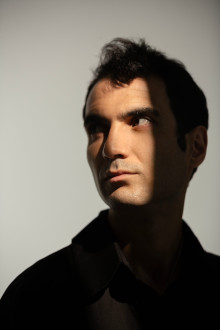
By that time he had moved to California, but Armenia called him back. It’s not the easiest place to live. Nearby wars (Yerevan is less than 200 miles from Urmia, the Iranian city that was bombed last Saturday), economic uncertainty and political instability–to say nothing of the memory of the 1915 genocide–loom over everyday life.
Hamasyan is undaunted. “I can be an Armenian living abroad, but I wouldn’t necessarily give my children the opportunity to really be carriers of that culture. So I decided to move back and raise my children here, at least for the time being, so they can absorb that culture.”
The pianist’s immersion in Armenian musical culture is so comprehensive that I was surprised to learn the method of its transmission. “It was through artists like Jan Garbarek, Keith Jarrett, John McLaughlin and Shakti. I came to Armenian music through that,” he said. “I heard a record of Jan Garbarek and Ralph Towner [Dis (ECM, 1977)] that kind of changed my life, honestly. I was like, ‘What the hell is this?’ At that time, I was really a bebop head, It was a different kind of musical vocabulary that he was using, and I took some records home with me that night and that was it.”
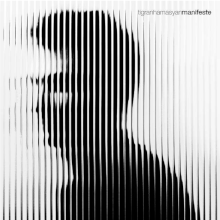
Though it contains moments of poignant musical austerity, Manifeste, is rendered on a grand canvas with textures that are almost orchestral in their density and saturation of color.
“I would love to be a composer full-time,” Hamasyan said. To that end, he has lately been studying European music from the medieval era and even earlier, including the hymns written by the Ninth Century Byzantine composer Kassiani, which is some of the most ancient music still performed.
Kassiani was a nun, but also a political figure who was said to have declared, “I hate silence when it’s time to speak.” For her 20th century counterpart Tigran Hamasyan, the time to speak is now.
Tigran Hamasyan Wed., March. 11, 7:30 p.m., Cleveland Museum of Art, 11150 East Blvd., Cleveland, tickets available here
For the most complete listing of jazz and jazz-adjacent events., look to Jim Szabo’s essential, weekly Northeast Ohio jazz calendar.
