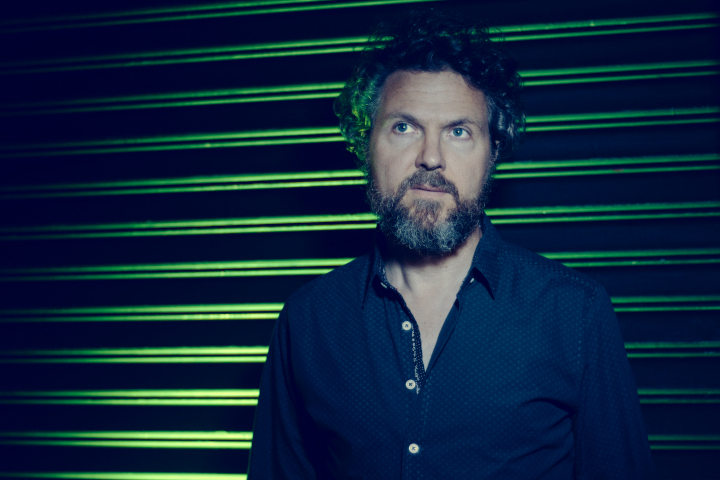
For centuries composers as varied as Handel and Hancock, Elgar and Ellington have drawn inspiration from the majesty and power of the world’s great bodies of water. Stephan Crump has been surrounded by water for nearly his entire life, but the large-scale composition he will bring to the Cleveland Museum of Art on April 24, examines the aquatic from a very different point of view.
After he read Canadian journalist Erica Gies’ book Water Always Wins, Crump became interested in what happens when human try to control the flow of waterways (spoiler alert: it’s not beneficial) and it got him thinking about how something similar happens in creative contexts.
“I’ve had some difficult experiences with bandleaders who were overly controlling, and I’ve seen what that does to the nature of presence of the members of the ensemble,” Crump said on a video call from his home in Brooklyn. “I’m more interested in allowing [my collaborators] maximum agency to express themselves and build the music in a truly collaborative way, and really making sure they feel like they are free to bring as much of themselves and what is true to themselves as possible.”
“Slow Water,” the extended work for sextet that Crump is bringing to CMA, is one such musical ecosystem.
“It’s composed of eight principal pieces, each of which evokes a certain wetland environment and is mostly through-composed. But there are areas in each piece–sometimes they won’t have notation—where they are invited to contribute whatever they feel is appropriate in order to build out this wetland universe, everything from burbling gases to insects in the air to wisps of grease and fog and any of the creatures.”
The music is evocative without being reductively pictorial, its subtlety aided by the unusual ensemble sonority. “Slow Water” scored for pairs of high and low instruments: trumpet (Kenny Warren) and trombone (Jacob Garchik); violin (Erica Dicker) and viola (Fung Chern Hwei). Yuhan Su’s vibes bring an aqueous shimmer to the ensemble while Crump’s bass is at the center of the sound.
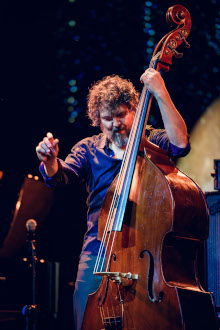
The bassist is no stranger to varied instrumental lineups—nor to Cleveland. He has appeared six times at the BOP STOP in the last 11 years with five different ensembles: in duo with guitarist Mary Halvorson, in a microtonal quartet with pianist Cory Smythe and saxophonist Ingrid Laubrock, leading his spiky two-horn-and drums quartet Rhombal, twice with the twin-guitar Rosetta Trio, and last year as a solo artist.
He’ll return to the Hingetown club on June 18 with the commanding saxophonist Darius Jones and drummer Eric McPherson: the Otherlands Trio. Miss that at your peril, but other lands will have to wait while the Slow Water tour runs its course
A highlight of the tour is a concert at the University of Illinois’ Krannert Center at which Crump and Gies will deliver a joint artists’ talk. Crump hopes the event will attract “science students and writing students and musicians and hopefully inspiring others to engage in these interdisciplinary collaborations and sharing with them what the benefits of that can be, not only for learning and discovery, but in developing their own artistic practice and compositional process.
“’Slow Water’ is about world building and collectivity rather than individuals and solos. And it’s more about relinquishing ego and falling into the concept and falling into each other and into the music over and over again and not forcing the issue, but trusting instead that with the right collective intent, just allowing the music to meander and deepen, that fertile wonderlands might appear. And it turns out that they do.”
Stephan Crump: Slow Water, Friday, April 24, 7:30 p.m., Cleveland Museum of Art, 11150 East Boulevard, Cleveland Tickets, $25-45, available here.
For the most complete listing of jazz and jazz-adjacent events., look to Jim Szabo’s essential, weekly Northeast Ohio jazz calendar.
