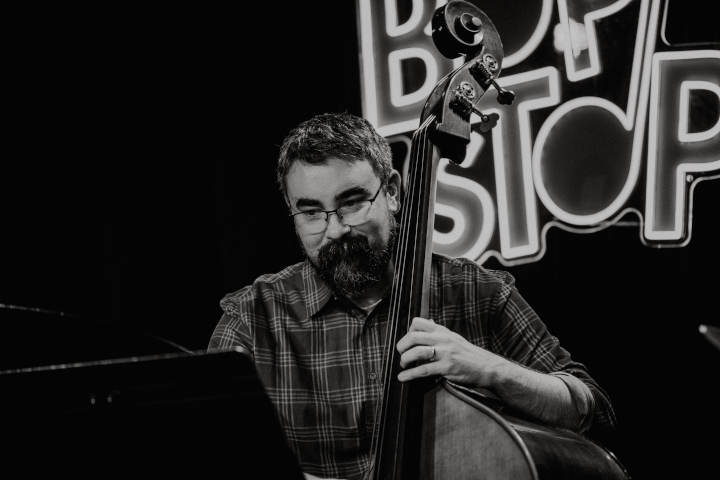
Yet working at the high end of low-end mastery leaves little time for personal projects. Lately, though several recordings have arrived to remind us—as through we needed a reminder–of Plank’s artistry.
“As a musician and an improviser, so much of [your work] just completely disappears the moment after it’s done,” the bassist said last week from his Twinsburg home. “So I feel like I’m trying to document things a bit more. I think I have colleagues that also feel that way.”
Some of them undoubtedly are on Where We Started, released April 24 on Stephen Philip Harvey’s Hidden Cinema Records label. You know the names: veterans like Howie Smith, Jack Schantz and Kip Reed, and newcomers such as Garrett Folger, Patrick Graney and Zach Warren.
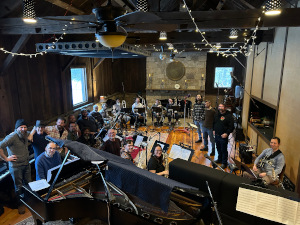
All of the arrangements and seven of the eight compositions on Where We Started were composed by Plank. Yet composition didn’t come easily to him. Showing up to play a performance really never felt stressful,” Plank said. “But when I started writing things and bringing them in for ensembles like the Cleveland Jazz Orchestra or other people to play, it felt like I was like 13 again and getting completely humiliated on stage.”
In time, and with experience, Plank’s confidence grew. “If you want to write large ensemble jazz music, you just have to be willing to be criticized and have stuff performed that doesn’t sound all that good. It’s just like when you’re learning how to take a solo. When you start off, they’re not that great, but you get better at it. And so the same thing goes, I think, with writing. I feel like I’m getting better at it.”
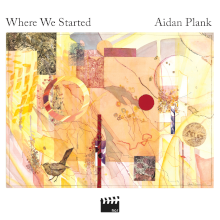
Plank might be selling himself short. Where We Started reveals a compositional voice with astonishing range. Half of the eight pieces are for an 18-piece large ensemble, two for a mid-size ensemble with Chelsea Selvaggio’s vocals and two solo pieces, one for Charlotte Beers Plank’s piano and the other on which Plank, not on his usual acoustic bass, but on a heavily processed electric, makes his only appearance on the recording.
That piece glows with the unhurried, summer-morning optimism and wide-vista harmonies of Maria Schneider, whom Plank cited as an influence. But influence doesn’t tell the entire story. Both are Midwesterners who grew up in similar landscapes, Schneider in rural Minnesota and Plank in Oberlin, a community to which he will soon return to live. So, is there a “Midwestern sound” in jazz?
Plank concedes the notion. Still, if he belongs to this lineage, it wasn’t by choice.
“If I had taken the plunge and moved to New York in my early 20s and stayed there, maybe my music would sound more like that, but I’ve stayed for the most part in spacious places,” he said. “We can’t separate that from who we are, and if we’re making sincere, honest music, who we are comes out in it.”
If that musical “place” can be located, it might be in the singular catalog and aesthetic of ECM Records. “I could talk about ECM all day,” Plank said. “It’s such an incredible label, and when I was so inspired to want to do this music thing, that label was a huge, huge part of it.”
Spaciousness is a big part of the ECM sound, but it’s a more ruminative space, perhaps that of the mountaintop rather than the American plains. Whatever it is, you can hear it in two self-released recordings from 2025, the eponymous recording by the Pulse quartet, with pianist Anthony Fuoco, drummer Dustin May and saxophonist Brad Wagner, and on DUO with trumpeter Garrett Folger.
“Garrett’s remarkable,” Plank said. “That’s become a really nice duo we have together … that sounds very much in the tradition of the early ECM recordings by Scandinavian musicians– people like Jan Garbarek and Edward Vesala and people like that. What I hope people find in my record, is a vulnerable look at who I am, and certainly where I’m coming from.”
For the most complete listing of jazz and jazz-adjacent events., look to Jim Szabo’s essential, weekly Northeast Ohio jazz calendar.
